|Advisement Page
|ClassConnections Page|
Hoover's Scheduled Classes 1998-99|
|Summer Graduate Film Workshop|
|Graduate Programs|
|Hoover's Teacher Resource Site|


(Return to Graph Table of Contents Page)
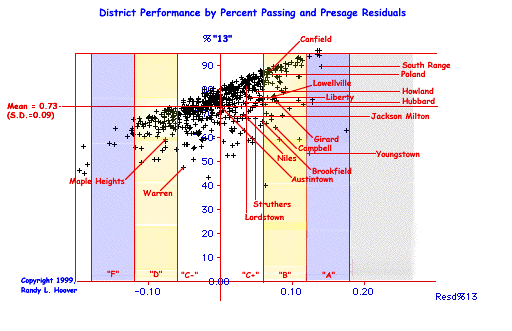
This graph grades districts based upon whether districts are performing above, at, or below what the Presage Factor predicts (residual scores). The grading scale is based upon the power shown by the Presage Factor's ability to predict performance... in other words it is based upon the correlation coefficient's significance (r=-0.74). Note though while this means for assessing school district performance results in an easy to read system ('A' through 'F'), it is not without its weaknesses in perhaps slightly under estimating performance of very high scoring districts (high in terms of % passing) and slightly over estimating performance of very low scoring districts (low in terms of % passing). However, as one element of a multi-element system for assessing district performance it is, I believe, reasonable.
There is also an interesting by-product of this graphical analysis. There is a strong correlation between percent passing and residual performance (r=0.60). What this says is that lower scoring districts tend to perform below expected performance and that higher scoring districts tend to perform above expect performance. We will discuss this finding in class. This finding has some interesting spin for a district such as Youngstown City in that YCS strongly bucks this correlational trend by showing a significantly high, positive residual score signifying above expected performance where most districts within the YCS range of Presage scores perform below expectations. In other words, this is another source of evidence I would offer in support of the case for giving credit to YCS for doing a good job schooling the city's children.
---Note: The grade categories are defined by using the standard deviations of the residual scores.