
The following are graphic representations of regression statistics used to show the correlations between the precent of students passing the Proficiency Tests and other variables. Most simply put: The greater the correlation between two variables, the more the regression line will be at a 45 degree angle to either axis.Each graph shows the algorithm for the line created by comparing the two variables (yes, my students, it IS y=mx+b). Also shown is the correlation coefficient (r) which indicates, numerically, how close the correlation is. As the value of r gets closer to 1.0 or -1.0, the stronger the correlation. A perfect correlation would be where r=1.0 or r=-1.0. In the case where no correlation whatsoever exists, r=0. When there is a negative value for r, it signifies an inverse correlation. In the brief comments that follow each graph, the coefficient of determination R is given. R is derived from squaring r and suggests the degree of causality that may be associated from one variable to the other. It is extremely important to note that the coefficient of determination does not definitively establish causality, it is used to suggest the strenght of possible causality.
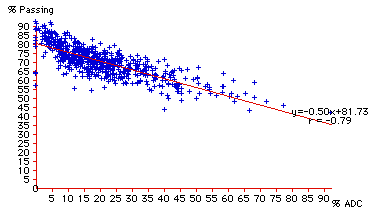
Statistically speaking the inverse correlation between the percent ADC and the percent passing is extremely high. ADC is used as a measure of poverty where the fewer receiving ADC, indicates the greater the wealth of the community. So in this sense, we find one strong indication that economic condition of the family of the student is a strong predictor of whether or not the student will pass the Proficiency Test. The coefficient of determination for this regression analysis is 0 .62, extremely high and suggestive of ADC conditions being very significant in affecting how students in a given district score on the tests.
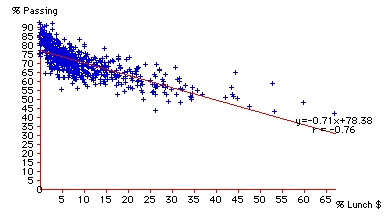
Very similar to the results shown in Figure 1, Figure 2 adds strong additional correlational evidence for the strength of the connection between social-economic status and Ohio Proficiency test performance. Again, a correlation coefficient of 0.76 (R=.58) is an extremly high result for any regression analysis.
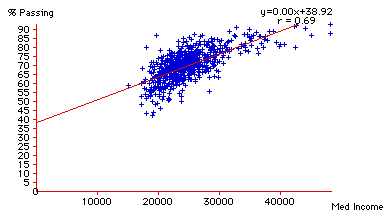
Figure 3 shows a strong correlation between median income and pass in the test. In the case of median income, please note that while I did the data analysis from which the graphs are generated, the data are taken from the Cincinnati Enquirer and that I did the statistically analysis from which these graphs are generated. My point is that median family income, while informative, does not substitute for mean family income correlation. To get a more thorough grasp of the effects of income, mean, median and mode incomes should be analyzed and compared. However, only data for median income were available. Median income can be a misleading average because a small number of famlies with significantly high incomes can distort the figure, making it seem higher than it is for families in general. However, even with this caveat, the data are striking in producing a correlation. coefficient of 0.69. The graph shows clearly that as the median family income goes up, so does the percent passing the Proficiency tests. I have done a simple, but somewhat interesting examination of the median income data itself, this can be found here.